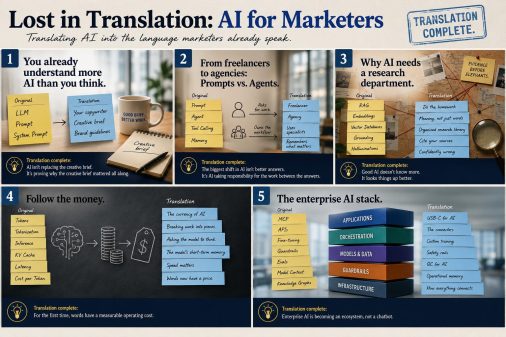
The story behind the “Lost in Translation” series, and why marketers don’t need to become AI engineers. They need to become better translators.
Over the past year I’ve noticed something interesting. When marketers ask me about AI, they almost never struggle with the ideas themselves. They struggle with the language. The conversation gets tangled in unfamiliar terms long before it reaches the underlying concepts. Context windows. Embeddings. MCP. Vector databases. Agents. It starts to sound less like a business discussion and more like someone emptied a box of refrigerator magnets onto a whiteboard.
The funny part is that this isn’t actually a new problem. Product marketing has always been an exercise in translation. We spend our careers standing between specialists and everyone else, taking deeply technical ideas and explaining why they matter. We don’t make the technology simpler. We make it more understandable. That’s a very different job.
As I found myself explaining AI concepts to colleagues, I realized I was reaching for exactly the same techniques I’d used throughout my career. I wasn’t defining jargon. I was looking for familiar landmarks. A context window became working memory. Prompt engineering started sounding a lot like writing a creative brief. Tokens felt suspiciously similar to media budgets. Once people had something familiar to anchor to, the technical vocabulary stopped feeling intimidating.
The Real Problem Isn’t AI
That realization became the spark behind my Lost in Translation series. It wasn’t meant to teach marketers how to become machine learning engineers. There are plenty of people far more qualified to do that. Instead, I wanted to build a bridge between two professions that increasingly need to work together but don’t always share a common language.
The more I thought about it, the more I realized this has always been one of marketing’s superpowers. We don’t just tell stories. We create shared understanding. The best marketers instinctively search for analogies, metaphors, and familiar experiences that help people connect new ideas to existing knowledge. AI doesn’t change that. If anything, it makes that skill even more valuable.
Every new technology develops its own vocabulary. Sometimes that’s necessary because the concepts really are new. Other times it’s simply the natural shorthand that develops inside a community of experts. Neither is inherently good or bad, but it does create friction for everyone standing outside that circle.
Translation reduces that friction.
An Old Lesson from an Analog World
There’s another reason this resonated with me, and it has nothing to do with AI.
As much of a digital native as I pretend to be, I’m really a carpetbagger from the analog world.
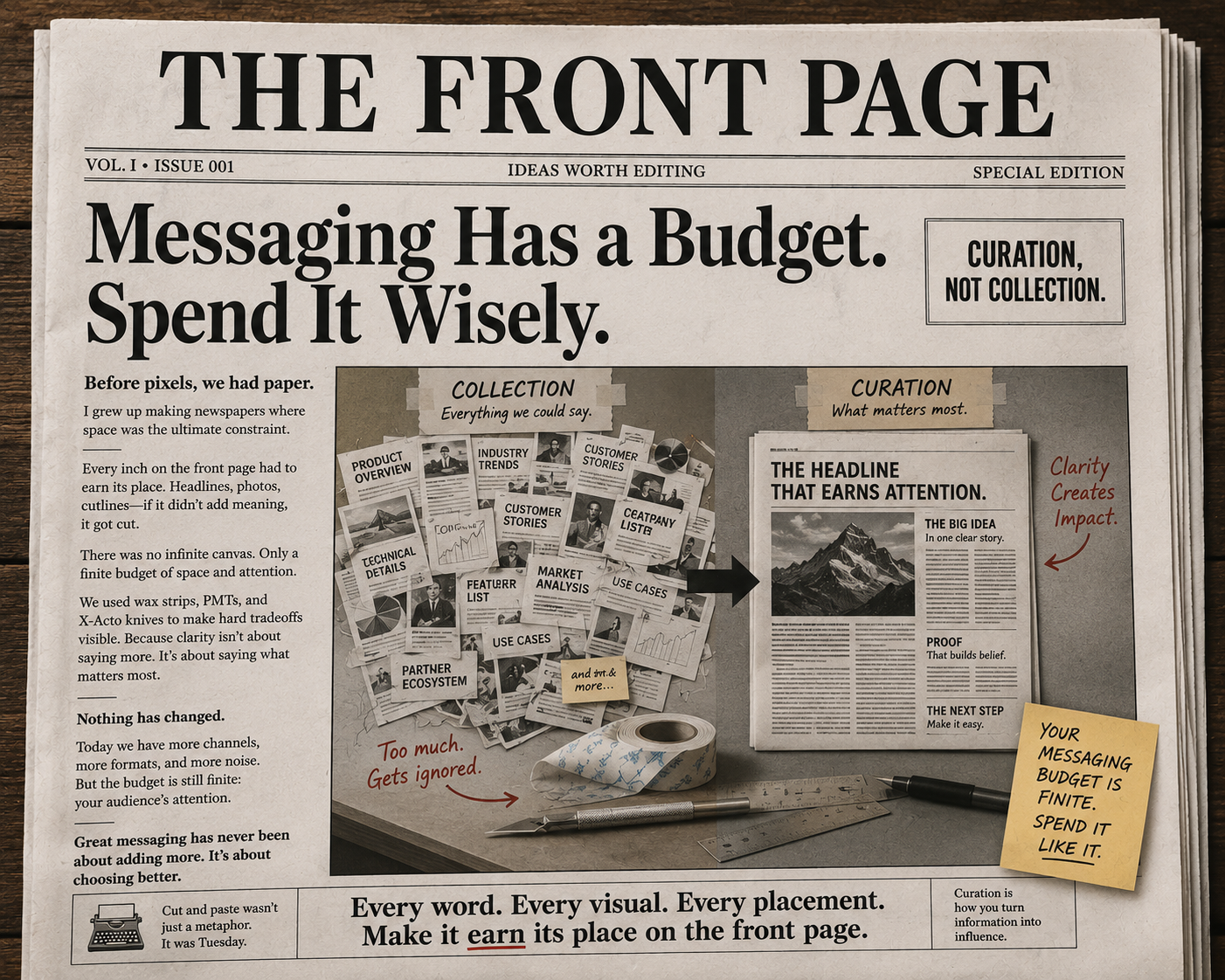
I learned to communicate laying out newspapers. This was back when Aldus was a software company instead of simply a typeface legend. We worked with PMTs, wax strips, X-Acto knives, and galleys. Cut and paste wasn’t a keyboard shortcut. It was Tuesday evening over a light table.
The most valuable lesson from those years wasn’t typography or page layout. It was editing.
Every front page had a finite amount of space. Every headline, photograph, pull quote, and story had to justify its existence. If something important deserved to go onto the page, something else had to come off. There was no infinite canvas. You couldn’t solve the problem by making the newspaper larger.
I’ve come to realize that AI conversations have exactly the same constraint.
Every Conversation Has a Messaging Budget
Whether you’re writing a keynote, building a product launch, creating a campaign, or explaining AI to a colleague, you have a finite messaging budget. Every new concept competes for attention. Every acronym consumes cognitive space. Every technical detour risks losing the audience before you’ve reached the point that actually matters.
That’s one of the reasons I’ve become increasingly interested in what I call a messaging budget. We often talk about adding messages, adding features, adding proof points, adding differentiation. Rarely do we spend enough time deciding what deserves to be removed.
The same discipline that once forced newspaper editors to choose between two stories now forces modern communicators to decide which AI concepts actually matter for a particular audience.
Not every good idea belongs in every conversation.
Translation Is the Job
That’s why these posts aren’t really about AI. They’re about communication.
They’re about helping marketers realize they already possess many of the skills this new era demands. They know how to understand audiences. They know how to simplify without oversimplifying. They know how to build bridges between experts and everyone else.
Those aren’t legacy marketing skills. They’re becoming essential AI skills.
The technology will continue to evolve. New models will appear. New frameworks will replace today’s buzzwords. New acronyms will inevitably find their way into conference presentations and product announcements. Translation, however, is timeless.
The job has never been to know every technical detail. The job has always been to help people understand why those details matter. That was true when I was cutting galleys apart with an X-Acto knife. It’s just as true now that we’re trying to explain AI.
 Techno Tchotchke