Blog

  • Lost in Translation: Why I Started Translating AI for Marketers

    This article is the origin story behind my Lost in Translation series, exploring why marketers need AI translators, not AI jargon.


    Over the past year I’ve noticed something interesting. When marketers ask me about AI, they almost never struggle with the ideas themselves. They struggle with the language. The conversation gets tangled in unfamiliar terms long before it reaches the underlying concepts. Context windows. Embeddings. MCP. Vector databases. Agents. It starts to sound less like a business discussion and more like someone emptied a box of refrigerator magnets onto a whiteboard.

    The funny part is that this isn’t actually a new problem. Product marketing has always been an exercise in translation. We spend our careers standing between specialists and everyone else, taking deeply technical ideas and explaining why they matter. We don’t make the technology simpler. We make it more understandable. That’s a very different job.

    As I found myself explaining AI concepts to colleagues, I realized I was reaching for exactly the same techniques I’d used throughout my career. I wasn’t defining jargon. I was looking for familiar landmarks. A context window became working memory. Prompt engineering started sounding a lot like writing a creative brief. Tokens felt suspiciously similar to media budgets. Once people had something familiar to anchor to, the technical vocabulary stopped feeling intimidating.

    The Real Problem Isn’t AI

    That realization became the spark behind my Lost in Translation series. It wasn’t meant to teach marketers how to become machine learning engineers. There are plenty of people far more qualified to do that. Instead, I wanted to build a bridge between two professions that increasingly need to work together but don’t always share a common language.

    The more I thought about it, the more I realized this has always been one of marketing’s superpowers. We don’t just tell stories. We create shared understanding. The best marketers instinctively search for analogies, metaphors, and familiar experiences that help people connect new ideas to existing knowledge. AI doesn’t change that. If anything, it makes that skill even more valuable.

    Every new technology develops its own vocabulary. Sometimes that’s necessary because the concepts really are new. Other times it’s simply the natural shorthand that develops inside a community of experts. Neither is inherently good or bad, but it does create friction for everyone standing outside that circle.

    Translation reduces that friction.

    An Old Lesson from an Analog World

    There’s another reason this resonated with me, and it has nothing to do with AI.

    As much of a digital native as I pretend to be, I’m really a carpetbagger from the analog world.

    I learned to communicate laying out newspapers. This was back when Aldus was a software company instead of simply a typeface legend. We worked with PMTs, wax strips, X-Acto knives, and galleys. Cut and paste wasn’t a keyboard shortcut. It was Tuesday evening over a light table.

    The most valuable lesson from those years wasn’t typography or page layout. It was editing.

    Every front page had a finite amount of space. Every headline, photograph, pull quote, and story had to justify its existence. If something important deserved to go onto the page, something else had to come off. There was no infinite canvas. You couldn’t solve the problem by making the newspaper larger.

    I’ve come to realize that AI conversations have exactly the same constraint.

    Every Conversation Has a Messaging Budget

    Whether you’re writing a keynote, building a product launch, creating a campaign, or explaining AI to a colleague, you have a finite messaging budget. Every new concept competes for attention. Every acronym consumes cognitive space. Every technical detour risks losing the audience before you’ve reached the point that actually matters.

    That’s one of the reasons I’ve become increasingly interested in what I call a messaging budget. We often talk about adding messages, adding features, adding proof points, adding differentiation. Rarely do we spend enough time deciding what deserves to be removed.

    The same discipline that once forced newspaper editors to choose between two stories now forces modern communicators to decide which AI concepts actually matter for a particular audience.

    Not every good idea belongs in every conversation.

    Translation is the Job

    That’s why these posts aren’t really about AI. They’re about communication.

    They’re about helping marketers realize they already possess many of the skills this new era demands. They know how to understand audiences. They know how to simplify without oversimplifying. They know how to build bridges between experts and everyone else.

    Those aren’t legacy marketing skills. They’re becoming essential AI skills.

    The technology will continue to evolve. New models will appear. New frameworks will replace today’s buzzwords. New acronyms will inevitably find their way into conference presentations and product announcements. Translation, however, is timeless.

    The job has never been to know every technical detail. The job has always been to help people understand why those details matter. That was true when I was cutting galleys apart with an X-Acto knife. It’s just as true now that we’re trying to explain AI.

  • Potatoes, Pride, and Diversity

    Potatoes, Pride, and Diversity

    It inevitably happens every Pride Month – someone trolls one of my personal or our corporate posts harping that we shouldn’t be talking about diversity. And as an aside, so glad that there is a troll emoji in the latest update!  I usually just ignore and block said 🧌, but this time, coming right back from vacation, I had the energy to educate. And while it may be quixotic (as well as mixing metaphors) I thought I would try and explain why diversity is a very good thing for the workplace.

    As an American of recent Irish ancestry I grew up not just having meals where multiple types of potatoes were served, but also hearing about the Irish Potato Famine regularly. As a skeptical kid, I never understood how a crop failure could wreak such havoc  – over one million dead. Only as an adult did I fully understand, and it taught me a valuable lesson about diversity.  

    I remember seeing the ancestral family land with adult eyes a decade ago and wondering how they could raise 12 children to adulthood on such poor, rocky soil. The answer was the potato. It is hardy, nutritious, calorie-dense, and easy to grow in Irish soil. By the mid-1800s nearly half of Ireland’s population relied almost exclusively on potatoes for their diet, and the rest incorporated it regularly in their diets.

    But in the 1800s, Irish farmers became entirely dependent upon one type of potato – the Irish Lumper. The Lumper flourishes in nutrient-poor and wet soil and was adapted to growing conditions in Ireland, particularly western Ireland. Lumpers were grown from clones of one another – monoculture – that were well adapted to the local conditions and helped feed the growing Irish population. As long as conditions were good. 

    But when the environment changed and the blight swept through the country in the 1840s, the potatoes and the Irish population dependent on them were devastated. The genetically identical Lumpers were all very susceptible to blight, which turned them into inedible slime. Because Ireland was so dependent on this one strain of potato, one in eight Irish people died of starvation in three years during the Irish potato famine of the 1840s.

    Yes, I know that was a long introduction and more than enough discussion of potatoes to push your glycemic index to dangerous levels.  But, just like evolutionary theory teaches us that populations with low genetic variation like the Lumper are more vulnerable to changing environmental conditions than diverse populations, the same is true in the workplace. 

    When we think about team dynamics and workplace productivity, it’s easy to get trapped in the idea that quick alignment is the best path to success. And it is true that a consistent corporate culture is shown to have a positive effect on productivity. It can also be easier to build a team if everyone comes from the same background, is the same gender, has similar education, and other common characteristics. 

    But there’s a dark side to the “monoculture” mentality, and it is dangerous to let its blight infect your team or company – groupthink.  Groupthink is the tendency for members in a given group to gradually drift toward the same beliefs and styles of thinking. It has been shown to lead to conformity of thought, resistance to change, and rejection of potential risk. There are numerous business cases documenting groupthink failures or near failures, because teams and companies aligned their views too narrowly, ignored upstart competition, and were reinforced by groupthink. Bottled water would never be a threat to the soft drink industry, the iPhone didn’t have a keyboard and couldn’t compete with Blackberry, and even the ice shipping industry of the 1800s turned down the patent for ice-making machines because that wasn’t their business.

    The best way to build an agile business that can weather the inevitable market and technology changes is to encourage diversity of thought, and the easiest way to build that is to bring together people from diverse backgrounds and create an environment where they can voice their opinions to contribute new approaches. Even just having someone challenge preconceived notions can help make a business plan more sound. With highly diverse teams, contrary opinions will be more commonly voiced, helping break the myopia of groupthink and enabling great ideas to turn into great products that meet and adapt to market needs.

    I can think of countless examples of times when someone from a different work, environmental, educational, gender, etc… background raised a point about a product plan that made the team rethink how we developed it or took it to market and ended up making the project more successful.  

    So, my dear Lumper Troll, this is why companies care about and foster diversity. 

  • Top X Things You Need to Know About WEKA X

    Top X Things You Need to Know About WEKA X

    (repost from https://www.weka.io/blog/)
    Today we announced the launch of our new global channel partner program – WEKA X – that lets our value-added resellers (VARs), system integrators (SIs), and managed service providers (MSPs) take advantage of a comprehensive toolkit of training, certifications, exclusive pricing, and incentives to streamline deal registration and help to build a profitable business with WEKA.

    I am super excited about the program and the feedback from our partners who have previewed it and could go on forever about the benefits and details. And since “X” is a long-standing way to represent the number 10, I decided to let “X” both guide how I told you more about the program and be the star of the post.

    X.  The “X” in WEKA X stands for, wait for it…

    I keep getting asked about the “X” in WEKA X and it’s a simple answer: X factor. WEKA is the X factor partners need to get deals done. The WEKA Data Platform provides an advanced architectural approach that can be the difference for companies trying to accelerate their business, and for the resellers helping those companies transform how they approach these workloads. The WEKA Data Platform was born in the cloud and is the only data platform that can seamlessly and sustainably meet the performance and scale demands of next-generation workloads on-premises, in the cloud, at the edge, and in hybrid environments.

    IX.  Customers are at a X-roads and need help

    We are at a crossroads where organizations of all sizes have significantly increased their investment rate in next-generation technologies such as AI, ML and HPC to solve challenges, fuel research and discovery, and innovate new business models. But they are struggling with where to invest. Gartner, for example, estimates that 85% of AI projects fail. WEKA brings a data platform combined with the expertise of our channel partners to dramatically reduce the risk on these projects and deliver successful outcomes for customers.

    VIII.  Legacy approaches are X_X

    Traditional infrastructure, architectures, and data management approaches can’t keep up with the requirements of these next-generation applications and workloads and are one of the reasons for the failures mentioned above. This is paving the way for a full-stack overhaul (CPU to GPU, VMs to containers, on-prem to hybrid cloud, etc) that presents a significant opportunity for the channel.

    VII.  It’s all about Xceptional customer outcomes

    To help customers evolve into AI-driven organizations quickly and build core-to-edge-to-cloud data pipelines, partners need new technology, education and training. At WEKA, we have a proven track record of bringing technology to customers that is highly impactful to their operations and infrastructure. WEKA X now pulls extensive partner expertise into the equation to help de-risk everything from purchasing and architecture to planning and deployment, and to help understand what is needed to create the best outcomes.

    VI.  Xtreme opportunity

    AI adoption has skyrocketed over the last 18 months. Previously only the largest companies were focused on AI, but now companies of all sizes are taking on AI projects. AI spending in the United States is projected to double by 2025 to $120 billion. WEKA’s expertise in enabling some of the most successful AI, ML and HPC solutions will help our partners open the doors to new opportunities with customers.

    V.  What is the f(X)?

    In math and common parlance, “x” can represent the unknown. But not with WEKA X, where the function of “X” is to stand for all the education, tools, training, and more that we provide our partners to help them deliver successful solutions built on WEKA for performance-intensive workloads such as AI and HPC.

    IV.  eXascale solutions

    WEKA is known for performance, purpose-built for the most extreme and demanding workloads on the planet. But did you know that the extreme “Impossible” workloads are also typically characterized by massive scale? Being able to handle exabytes of data with billions of files accessed by thousands of servers is a new challenge as data grows exponentially. WEKA partner expertise in these areas is critical to making these exascale projects successful.

    III.  Solve for X where Y = great partners

    WEKA X is designed to help partners and customers be as successful as possible. By ensuring partners have comprehensive training and are capable of delivering top-notch solutions – and outcomes – the opportunities for partners to grow are fantastic. Customers reap the benefits as well by being able to choose best-of-breed expertise on solutions for infrastructure as well as applications and code that are integrated into customer workflows.

    II.  X2: The power of two

    There is power in numbers, strength in numbers, and success in numbers. WEKA X not only represents a new and exciting program for our partners, but it enables the power of both WEKA and our partners’ teams to provide customers the benefit of our combined experience with and knowledge of cloud, hybrid, and on-premises solutions. X to the power of 2 is focused on our customers’ continued success to meet and exceed their goals and objectives for their organizations.

    I.  X marks the spot for success

    In addition to being an ode to X, this is a set of X reasons why the WEKA X Partner Program delivers an optimized partner experience to help our resellers take advantage of our game-changing WEKA Data Platform and the tremendous market opportunity for compute-intensive workloads. WEKA X is an important step forward in making it easier for partners to get WEKA into customers’ hands and make them successful.

    Learn more about the WEKA X Partner Program

  • Is There an LOSF Monster Lurking in Your Data Center?

    Is There an LOSF Monster Lurking in Your Data Center?

    (Reposted from WEKA.io/blogs)

    Have you heard of the dreaded LOSF beast? While recognized in academia and the industry, like Bloody Mary of folklore, many are afraid to say its name out loud out of fear that it will appear and cripple their digital transformation engines.

    While at first glance your data center may look like a safe place, it is rife with danger that can make the hairs on the back of your neck stand up — despite the climate control. Are the blinking lights a subtle M. Night Shalyman-style warning of costs that may soon spiral out of control? Is the fan noise secretly hiding an impending attack of a performance or reliability issue?

    One of the other potential horrors is the rise and growing importance of applications that use lots of small files (LOSF). While these apps may not sound scary, they can be a terror for your legacy data architecture and the demise of many an HPC cluster.

    What does this boogeyman actually look like? The ghastly LOSF beast can often produce not just millions, but billions of small <1MB size files, and sneakily mix them among large files. And to make matters even worse, this size may be on the large end. Many of the files in these workloads are only a few kilobytes in size or smaller. LOSF applications are common in social networking sites, electronic design automation, high-performance computing, natural language processing, and life science research.

    The LOSF monster feeds on challenges in metadata management, access performance, and storage efficiency to maim and cripple these applications on-premises. Many an LOSF workload has completely paralyzed customers when they have tried to move these “impossible” applications to the cloud.

    How the Beast Was Born

    The gruesome LOSF monster wasn’t conjured with blood magic, maiden sacrifice, or even a creepy board game found in the attic – it spontaneously emerged to take advantage of the curse of legacy data architectures. File system “houses” that originally focused on the HPC space, such as Lustre, GlusterFS, GPFS, and HDFS were originally built on ground cursed by slow, cobweb ridden hard drives. As these large mansions went up on this land they were limited by an architecture designed for high aggregate bandwidth for large files, including how they dealt with metadata management, data layout, striping design, and cache management.

    As new, high performance, small file workloads moved into these creepy old houses at the end of the block, there began to be eerie warning signs – random creaking in the data center, sudden hot spots, workloads that suddenly stopped and started, and the blood curdling wailing of data scientists echoing through the halls.

    At the source of the hard drive curse that enabled the emergence of the LOSF beast is metadata management. When a file needs to be read or written, the client asking for it first makes a request to the storage to lookup or find the appropriate location, then it opens the location, does its read/write, and then closes the location. This means that for each data movement, there will be multiple operations swapping metadata from disk to memory at a tremendous rate, slowly bleeding out the performance of the architecture. This is what attracted the LOSF monster and what sustains it going forward.

    The Monkey’s Paw

    As more LOSF workloads move to the cloud, surely existing cloud storage offerings can tame this beast, right? As with the Monkey’s Paw, there are consequences to every wish… While most object store implementations in the cloud can handle the scale of billions of files, the performance is far too slow for any of the next-generation workloads. The enterprise storage vendors that have moved to the cloud have just moved their same cursed architectures along with them and in some cases have made it worse. Like Freddy without his claws, the ability to tune in the cloud to meet the LOSF beast head-on is limited or lost.

    Don’t Abandon All Hope

    One of the key tenets of any good horror movie is that you will regret going back into the spooky old house. And no matter how many flash-y exorcists you bring in to stop the beast, it still wont change the decades old curse. And Jason will be back for yet another sequel.

    The WEKA Data Platform isn’t burdened by the sins of the past and has the silver bullets to smite the LOSF monster at first sight. WEKA is armed with the fresh approach of creating virtual metadata servers that scale on the fly with every server that is added to the cluster. Along with WEKA’s super secret data layout algorithms which spread all metadata and data across the cluster in small 4k chunks, this creates incredibly low latency and high performance whether the IO size is small, large, or a mixture of both and keep the LOSF monster at bay,

    And because the WEKA Data Platform is software-defined, the exact same technology is used whether on-prem or in the cloud, finally stopping the curse of the Monkey’s Paw: no tradeoffs for performance or capacities in the cloud.

    For a more detailed – and less creepy – look at the challenge of LOSF, check out our Lots of Small Files solution brief.

  • I No Longer Work at a Storage Company…

    I No Longer Work at a Storage Company…

    …and 5 Facts to Back That Up

    I started a new job at WEKA late last year and received a lot of compliments here and IRL. But every so often I would get a message or be pulled into a conversation that mentioned me working at yet another storage company which led to a conversation about what WEKA actually helps customers do. I’ve responded in private quite a few times, so I decided to write a post about it.

    Let’s get this straight: While I am proud of the kick ass work I have done at storage companies over the last 20 years, I am not working at another storage company! WEKA is a Data Platform company and one focused on AI and other modern, high performance workloads. And no, “Data Platform” is not marketing buzzwords meant to make old technology seem more appealing. We really are very different from the storage companies I have worked at. And here are 5 reasons why!

    #1 First and foremost, we don’t sell disks. 

    WEKA sells software as a subscription that is highly scalable and easy to deploy, configure, manage, and expand – be it on-premises or in the cloud. On-premises, we are hardware agnostic and able to run on almost every hardware out there – from multiple server vendors, with multiple types of NVMEs drive, using multiple CPU choices, feeding data to multiple types of GPUs, and on multiple clouds. The WEKA Data Platform runs on servers from our customers’ preferred vendors and can be bought in bundles from them too. This makes ordering and managing it much simpler than a separate storage appliance. Our software can be deployed on standalone server nodes or for zero extra footprint in a “converged” configuration on the servers that run the workloads.

    #2 We are a cloud software company – who also run on-premises. 

    I mentioned cloud above, but it deserves a full call out. The WEKA Data Platform was designed to be cloud first and then ported to on-premises. And as a result, it allows for total data portability and management across multiple environments – cloud or on-premises or both. Try getting the same <insert legacy storage array name here> experience in AWS and on premises. And for bonus points, try enabling hybrid workflows between them! WEKA gives customers a consistent data platform across any environment, be it on premises, in the cloud or both. And too often “hybrid storage” means limited cloud capabilities like snapshots or backup. WEKA customers are using the data platform for a plethora of cloud uses – bursting from on-premises to the cloud as needed, supporting sophisticated hybrid AI workflows, and migrating workloads to AWS Outposts or the AWS cloud.

    #3 We treat all types of workloads equally – blazingly fast. 

    Storage systems are usually architected to excel in a limited number of performance dimensions while others languish, requiring different storage arrays for different workloads. But WEKA performs across all dimensions without the need for tuning or re-configuration, customers can run any part of their data pipeline on a single system, whether it requires massive IOPS with small reads and writes, or massive throughput and 10’s to 100’s of GB/sec. But it’s not the speed that is important – it’s what it means for our customers. It allows them to have just one storage system for the entire data pipeline and save money from having to buy and manage multiple storage arrays and equally as important saving time from constantly copying data between them. 

    #4) We evolve as fast as our customers’ needs do. 

    Traditional infrastructure can take months to years to change. New hardware support or networking protocols are often only implemented in storage arrays years after they are released to the market.  And to get new features you often have to undergo painful data migrations and hardware swaps. We don’t lock customers into specific hardware platforms or previous generations of technology. Platforms are designed to be future proof  to be extensible and evolve with customer needs to take advantage of new innovations so their business and research can benefit. The WEKA Data Platform is designed to evolve at the speed of science to let customers quickly, easily and non-disruptively adopt new technology. 

    #5) We are faster than a storage array and we are even faster than local NVMe storage – by up to 3X! 

    Local storage means local resources only. We parallelize and gang together more NVMe resources than can fit in a single chassis, add a high performance networking stack as well as kernel bypass to service high performance workloads faster than local storage. A WEKA cluster can deliver up to 162GB/Sec & 1M IOPs to a single GPU client. Earlier this year, Samsung Datacenter Technology and Cloud Solutions used WEKA to bring their NVMe drives together in a storage cluster and achieved new number 1 records for 4 of the 5 SPEC Storage2020 audited benchmarks, all using an identical configuration across varied datasets and IO types. Yes, it’s a storage benchmark, but until a Data Platform benchmark is created it’s what we have to work with.

    I am very excited for my next, non-storage adventure at WEKA. If you want to learn more about the data platform, why not try it in AWS right now by going to https://start.weka.io. In addition to all the great benefits we bring to customers, I am working with a team of the best-of-the best from across our industry. And I am going to be hiring product marketers and technical marketers VERY soon so stay tuned for job postings.

  • Rewriting the Genetic Code of Storage

    Rewriting the Genetic Code of Storage

    (reposted from www.hitachivantara.com/blog/)

    Rapid, near-constant change is the defining state of today’s modern, digitally transformed business environment. As the past year has made painfully clear, it is time for a storage infrastructure and a storage strategy that can rapidly adapt. Such flexibility is essential to support the requirements brought about by new business conditions. Storage must enable business change and not be a disruption that slows or prevents progress.

    Evolutionary biology offers students of storage an interesting analogy. First posited by Stephen Jay Gould, punctuated equilibrium suggests that changes in species are not the result of slow incremental processes over millions of years, as previously supposed. Species instead undergo rapid, radical change in very compressed times periods in response to extreme pressure. Anything unable to adapt quickly is pushed out of its niche, fated to die out. After such periods, the world stabilizes, but it is fundamentally different.

    Incremental change while maintaining business resiliency has so far defined the history of data storage. Subtle improvements introduced over long periods of time have been the norm.

    That long period of stability is at an end. Business conditions are changing rapidly in many dimensions. The pandemic dramatically expanded the footprint of remote work. Cloud adoption, digital transformation, and dramatic disruption of operations are surging inexorably across many industries. Apps and rapid delivery have replaced visits to stores. Virtual collaboration has replaced in-person meetings. A virtual desktop streamed from the cloud that runs on any handy lightweight device replaces a powerful desktop computer.

    Stability has been the watchword in storage. Now the world needs its storage architectures to evolve quickly AND be stable. Today’s storage architecture must assume that change is the normal state of things. Storage arrays must be primed to support an ever-shifting mix of performance and cost requirements. Whether arrays target high-performance, balanced cost-performance, or lower-cost needs, all need to respond to the pressure of change. Even the end of a storage array’s life should be painless, with the transition to new arrays taking a matter of hours or days, not weeks or months, and never imposing disruption.

    Change is constant, and when it comes to storage arrays, it should be effortless. It should not introduce additional risk to your business. Three characteristics define the storage species emerging from the pressures of the era of change: efficiency, resiliency and agility. While all three terms are deeply ingrained in the DNA of storage, evolutionary pressure is hard at work to dramatically rewrite the code that defines each.

    Resiliency for When Things Go Wrong

    Way back in 1999, a single stroke of a backhoe digging earth brought the internet to a standstill for much of the Eastern United States. While a problem for some businesses, it merely inconvenienced many others at the time. Today such an occurrence would bring nearly every business affected to a standstill.

    Things can and will go wrong, and businesses can’t simply shut down when they happen. The ability to serve data at speed under any circumstances is not “nice to have.” It is essential to the survival of every business, regardless of its size. Things are going to happen. Performance under adversity has to be built into the genetic code of modern storage arrays.

    Also associated with resiliency is an awareness that all things have a useful life span. Technology constantly moves forward. Components wear out. Accidents happen. A business can’t just hang an “out to lunch” sign on its window when its infrastructure needs maintenance or upgrades. Storage arrays must be predictable no matter what happens. Punctuated equilibrium tells us that something big is going to happen and that event will force change. We may not know what it is or when it will happen, but we can design storage arrays prepared to continue to perform even as they undergo rapid evolutionary change.

    Efficiency Is About More Than Cost

    Data is being produced in ever-increasing quantities and at a rate that far exceeds the resources available at most organizations. Storage arrays must adapt to make it possible to store more data at a lower cost. That is a more complex challenge than simply making physical storage devices less costly. Storage arrays must offer choices of hardware and software that allow one array to offer numerous price/performance tiers.

    Efficiency is also a product of managing the increasing quantity of data without requiring an ever-increasing number of people to do the managing. Just as the transportation infrastructure is looking to autonomous cars, the world needs more self-driving storage infrastructure. Self-driving cars are expected to make travel safer by getting slow-reacting humans out of the driver’s seat. Similarly, in an increasingly congested digital world overrun with data, we need to leverage new technologies such as AI and machine learning to reduce the need for people to handle the care and feeding of storage constantly.

    In a world of constant change, we also need to consider how storage is acquired and deployed. Storage needs may be increasing, but an organization needs different types of storage at different times. Storage not optimized to current needs is inherently inefficient. Changing businesses need new ways to obtain the storage they need and then switch to different storage quickly when their requirements change.

    Agility Is the Key to Opportunity

    Punctuated equilibrium is not just about asteroid strikes and volcanic eruptions. It also embraces opportunism, allowing a species to swell into a new niche to make the most of some new resource. Storage agility is correlated with opportunity, empowering a business to adapt to take advantage of trends and change quickly. It’s how business thrives.

    Today’s businesses amas vast amounts of data, but not all data is the same. Some data is “cold data,” preserved for archiving, retention, backup, governance, and so forth. Then there is “hot data,” the stuff that actively courses through the veins of the business every day. While hot data has immediate, tangible value, there is no telling when cold data may suddenly be part of a hot opportunity. Storage platforms need to be able to morph to suit the rapid-fire pace of change. That may entail suddenly serving more users as the products of a business line change. As seen during the pandemic, businesses that formerly were primarily face-to-face operations now find themselves conducting predominantly online operations. Business patterns change, and storage platforms need the agility to support the business wherever it needs to go.

    At Hitachi, resiliency, agility and efficiency are what we think about today as we rewrite the genetic code of storage technology. Our objective is to enable your business to make the most of today’s evolutionary opportunities to emerge at the top of tomorrow’s phylogenetic tree.

  • Manifesto Destiny

    Manifesto Destiny

    Product Marketing isn’t the same as it was a decade ago. Heck, it isn’t the same as it was two years ago. 2020 radically accelerated trends that have been happening to my profession for a while. Customers aren’t engaging with our content in the conventional ways they used to. Traditional social media posts are not successfully converting into web page traffic. Millennials and digital natives who research and compare products in new ways make up a third of our buyers and that number will only grow.

    As product marketers, we are dedicated to bringing great products to market – products that delight customers, drive profitability and that help change the way people work and live. To that end, we need to use the best methodologies, tools and techniques to be most effective. But what do we adopt to best bring products to market? How do we promote them and sell them with all the changes in how we should engage customers in this new normal?

    Well, that is the question I posed to my team earlier this year and together we came up with a series of “intentions” for how a modern product marketeer should act to be successful. And could we capture those new directions in a way that we can use in recruiting, as a regular touchstone, and as something to communicate to the company at large? 

    The Manifesto

    Well, the team went off and noodled, iterated and reviewed with me and we came up with the following “manifesto” for how a modern Product Marketeer should, behave:

    Lead the Adventure

    We are the adventure guide and as such will be the voice of the product to teach instead of sell by sharing knowledge and expertise. We are both internal and external thought leaders. We will guide customers on their journey with engaging and insightful content based on our deep understanding of customer needs, the market, technology, competition, press, analysts, trends.

    In a New Tone

    The landscape is crowded with competitors all making similar claims in the same dull way. We will engage in authentic communication and speak insightfully, creatively, and candidly – occasionally using snark and humor to be slightly unconventional – to engage and delight our customers.

    Be Digital Native

    Digital is transforming the way our customers interact with and respond to technology. We will shift from primarily written content to heavy use of video, podcasts, social, AR, interactive content and emerging platforms.

    Content Uber Alles

    We will create timely, compelling anchor pieces that speak to business and personal pain, that will be refactored to target the “watering holes” where our audiences gather. As a result, we will work smarter not harder. We will engage our customers with compelling content across the latest digital platforms.

    Act, and Act Now

    What we say and write is the raw material for the rest of the company’s marketing functions. We must be the catalyst for these changes. There is no time for a long and drawn-out evolution. We must take it upon ourselves to act with urgency and implement these changes immediately to champion these new ways of communicating with our audiences.

    Making the Manifesto Reflexive 

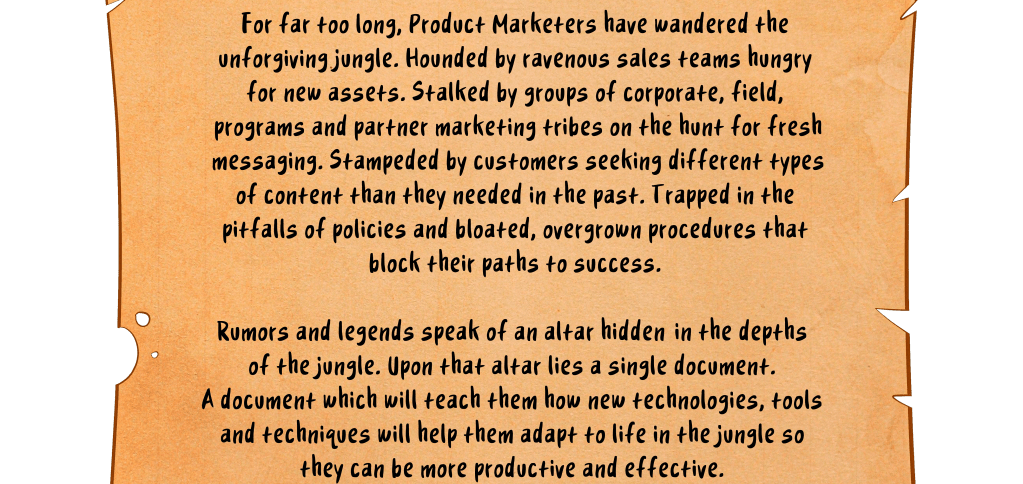
    We originally created the manifesto as a written document with significant explanations and calls-to-action each for each of the above points. But a whitepaper style document actually defeats the goal of what we are trying to achieve – it’s a lengthy written document that doesn’t embody many of the commandments of the manifesto. So, I challenged the team to live the manifesto in how we publish it and thus “Manifesto Destiny”, a comic book, was born.

    It tells the story of a product marketeer (who does not look like me) – lost in an unforgiving jungle, hounded by ravenous sales teams, and at risk of being stampeded by ravenous customers – who discovers the manifesto and uses it to help his colleagues escape common challenges and pitfalls we face. 

    It definitely has helped the team to focus on driving a new set of priorities and I am looking forward to seeing how it works in recruiting. Check it out below, and bonus points if you can spot the easter eggs – because of course all good content has some!

  • DIY Product Launch #FTW

    DIY Product Launch #FTW

    I have been in the data storage business for almost 2 decades now and have talked a lot about business continuity over the years. Typically, it is about how to keep your business running when technology fails you as a result of human error, power loss, or natural disaster. As a result of the COVD-19 pandemic, business continuity has taken on a new meaning – how do you keep your business running when you are separated from your technology and fellow co-workers. And, rather than just talking to customers about it, it’s a conversation I am having with my teams – and one where we don’t have ready-made solutions.

    Yours truly, final production

    As the pandemic spread and shut down business and social interactions, we were in the middle of preparing a product launch. We had a plethora of things to think about. Do you still do a launch? Would it still be in good taste? And if do you do it, how do you still tell a compelling story given the new limitations? The usual studio video shoot is out – can you get something of reasonable quality done by people at their own home?  Do you ship people complex equipment, or do you leverage what’s on hand? How do you make it look cohesive?

    Why do a product launch at all? One of my favorite crisis-related quotes is from Admiral Jim Stockdale – “You must never ever ever confuse, on the one hand, the need for absolute, unwavering faith that you can prevail despite those constraints with, on the other hand, the need for the discipline to begin by confronting the brutal facts, whatever they are.” And one way to have unwavering faith means that you need to proceed as best as you can on the assumption that the world will go on. And on the facts front, storage happens to be an essential business – storage solutions power heath care IT, support transportation systems, underly financial systems, and a host of other essential services that we rely on.

    "In front" of the scenes
    Home Green Screens

    So, once the decision has been made to continue, how do you actually pull it off? While it is not one of my rules, it is a very sound best practice to keep things as simple as possible, especially when so many other variables are unknown. So, we went with iPhones and a few simple gadgets purchased from Amazon for less than $300 per home setup – way less than renting a studio and hiring a crew!

    I am sure we have all seen advice on using lighting correctly, but key to making it look cohesive was using green screens and lighting them correctly! You need to light the screens separately from your face so that any shadows you cast from front facing lights are blown out. Thanks to some (repeated guidance) for our excellent video team positioning these lights behind the speaker and before the green screen eliminate the shadows and made the composting of a common background easy!

    Green screen layout

    We recorded everything in 4K at 30fps.  I had issues recording at 60 fps – the video would randomly record in slow motion. It was also interesting that the auto-focus worked better on the rear-facing camera. This required the use of some trial and error to make sure I was correctly standing in the frame. I ended marking my standing spots on the floor so I could come back to them in between takes. The Bluetooth shutter remote that came with the ring light was invaluable here to start and stop between takes. Just check periodically to make sure an errant click hasn’t accidentally started or stopped the recording.

    When I have done studio shoots, someone inevitably covers my forehead with anti-shine.  I tried two Amazon-recommended products to reduce shine and “create great selfies” but they ended up both being pretty white and cakey. I just ended up going au naturale. I also had to tamp down my curls as they were causing problems with the compositing.

    The process was a bit frustrating at times and I had to be willing to set different expectations for myself then I would for a studio shoot. With the help of some amazing editing, it turned out fantastic. Click here for the amazing full launch video (registration required). And stay tuned – I already have ideas for how to do some other interesting, shot at home video.

  • Take a Walk on the AI Side

    Take a Walk on the AI Side

    Hot Topics in AI Infrastructure Video Series

    Re-posted from https://blog.purestorage.com/aiinfrahottopics/

    Artificial intelligence (AI) is very much in the IT zeitgeist, promising new ways to serve customers and drive business. It’s in the news, movies, and advertising, but what does it really mean to your business? And how do you implement and manage AI infrastructure projects?

    When it comes down to it, most IT professionals don’t have much exposure to AI outside of select industries and use cases. AI is more than hype: it’s powering everything from facial recognition to digital assistants and self-driving cars today. 

    Enterprise demand for proven AI outcomes is growing. Companies are beginning to use the incredible computing capacity of their data centers to build powerful AI models. And organizations can use the massive amounts of data they’ve collected to train AI models to mine for insights. They are starting to predict customer churn, optimize supply chains, detect cancer in radiology images, and myriad other examples.

    We launched the AIRI™ joint AI infrastructure solution with NVIDIA last year. Since then we’ve had many conversations with data center leaders and IT practitioners who are focusing on infrastructure strategies for the AI enterprise. A frequent topic is how AI initiatives will consume data center resources and how to support the new data-science workloads. 

    To help IT specialists be more successful in operationalizing and managing AI initiatives, we are launching a “Hot Topics in AI Infrastructure” video series. 

    Join NVIDIA’s Tony Paikeday and me in a series of conversations on how you can get a jump-start on your AI journey. We’ll address the best way to get started with AI initiatives, talk about what skills you need (and the ones you already have), and cover common AI myths and misperceptions. 

    Each 2-minute episode addresses a single topic as we walk around NVIDIA’s Silicon Valley HQ.

    Our first episode focuses on how to get started on your AI journey—why you shouldn’t fear AI infrastructure projects and how to get involved in them.

    Check back every two weeks for a new episode. And, if you want to go just a little deeper, check out how the FlashStack™for AI offering can help you easily adopt artificial intelligence/machine learning technologies for your business without re-architecting the data center.

    Want more video content from Pure Storage? Click here to subscribe to Pure’s YouTube Channel. Additionally, stay current with the latest AI infrastructure resources and assets by following Pure Storage on FacebookTwitter, and LinkedIn.

  • The Heretofore Unwritten Rules for Product Marketeers

    The Heretofore Unwritten Rules for Product Marketeers

    33 Rules Product Marketeer Need to Know

    Being a product marketeer is a noble calling. We have the privileged task of connecting with our customers and building relationships with them across a wide variety of media and methods. We are so much more than people who can package various technical giblets into a coherent data sheet or make an ugly slide less so. We are the ones who describe not just what the product is, but tell a compelling story about how it will help our customers be better in what they care about.

    While there is a wide range of training to help product marketers hone their skills – courses on how to frame a story, how to speak and present with confidence, how to make good looking slides – I find there is a huge gap. No one covers the key soft skills required to become a successful and in-demand product marketeer. And worse, no one explicitly tells you what NOT to do.

    After a year’s hiatus, I have the privilege to manage a team again. In trying to find ways to do a high bandwidth brain dump to them on what I have learned about being a good marketeer, I decided to finally write down The Rules. These are sacred commandments passed on to me by great bosses and coaches; proscriptions I have though my own failures and by observing those of others; and simple truths I have learned over the course of my career.

    The Rules are not the be-all and end-all of product marketeering but meant to guide you on your journey to product marketeering Nirvana. They address skills across the spectrum of a product marketeers job – from presentations, to working in a team to career development and more. None of us are perfect and following The Rules is a career-long struggle. If you transgress against them, learn the error of your ways and vow not to do so again.

    The Rules

    Rule #1 – The Rules are Sacred
    Obey the Rules. If you transgress against them, learn the error of your ways and vow not to do so again.

    Rule #2 – Pass on The Rules
    It is your sacred duty to guide the uninitiated – the more initiates, the better place the marketing world will be.

    Rule #3 – It is Marketeer Not Marketer
    Marketers are how the tactical, uninitiated, describe themselves. Marketeers are focused on the total customer experience and acknowledge the rules.

    Rule #4 – Say It in One Slide
    You may never get off the first slide, so be prepared to start with a comprehensive summary. And, if you can’t explain it in one slide then you don’t know it well enough.

    Rule #5 – Stand When Presenting
    You need to own the room when presenting and it is nigh-on-impossible to do that from a seated position. And you had better make eye contact with key decision makers.

    Rule #6 – Each Slide Has One Job
    Audiences can’t easily grok multiple concepts jammed into a slide. Focus on making each slide a single takeaway. A similar concept applies to paragraphs of text. And if you work in tech, know the meaning of “grok”.

    Rule #7 – Real Differences Have Significance
    The only product differences worth focusing on are those that significantly benefit your customers, everything else is immaterial. It doesn’t matter that your product has state of the art Spacely sprockets if they don’t solve a work or personal pain point.

    Rule #8 – Animation is a Sign of Weakness
    Using animation to make a point in a presentation means you haven’t found a better, simpler way to do it. Only use it as a last resort when all other ways to tell your story have failed.

    Rule #9 – Respect and Police Your Brand
    We are guardians of the brand and deliver a consistent look and feel and ensure that others do as well. You should be able to recite the RGB codes for corporate colors as easily as your phone number.

    Rule #10 – Be a Renaissance Man or Renaissance Woman
    Great marketeers are well-rounded and curious personalities not the left brain driven analytical types. We synthesize facts and desires to build compelling stories and need to poke and prod to get them. We pay attention to other industries and how they use marketing.

    Rule #11 – Don’t Sell Past the Close
    Once your audience has agreed with you, sit down or leave. Don’t waste their time trying to provide more information or worse, say something that will make them reconsider.

    Rule #12 – Money is the Best Tie Breaker
    When trying to decide between two good choices, choose the one that will make more money for the company or the customer. And if it does both you know you have a winning idea.

    Rule #13 – Don’t Make Someone Else Carry Your Monkey
    Problems are monkeys, and don’t dump yours on the back of other folks. Instead, ask others to help evaluate pros and cons of potential solutions that you have developed do deal with your simian challenges. It’s your monkey, you deal with it – with help.

    Rule #14 – Never Confuse Selling and Installing
    Our job as marketeers is to build a broad, aspirational message and to tell the right story at the right time. Start big and broad, then slowly get into the weeds. Nitty technical considerations need to be addressed later in the sales cycle, not at the first customer meeting.

    Rule #15 – Know If You Are Selling The Car or the Cupholders
    Cup holders help consumers make a decision between two similar cars, but only once they have decided on a specific car type. Understand which features and benefits of your product are in each category and develop your messaging appropriately.

    Rule #16 – “Before Going Out, Look in the Mirror and Take One Thing Off”
    Coco Chanel’s advice also applies for your content – get in the habit of doing one final review just for the purpose of deleting things before you publish. Remember, less is always more.

    Rule #17 – Answer the Question That Was Asked
    And in the units asked for. Don’t start an answer by trying to dazzle with your deep knowledge. Answer what was asked and then elaborate as needed.

    Rule #18 – Work From Right to Left
    At a macro level this rule means you are more likely to have success if your work plan is developed by building your plan starting from the goal/deadline and in reverse order identifying the critical path to get there. At a micro level, it means tackle the most complete items before taking on new ones.

    Rule #19 – People are Either Pigs or Chickens, So Treat Them as Such
    The chicken contributes to breakfast, the pig gives a part of himself. Know who will do the work and who will advice or comment. Don’t be afraid to respond to a chicken’s suggestions with “thanks I’ll take that under advisement.”

    Rule #20 – Value is What Customer Will Pay For
    This is corollary to Rule 12, but focused on prioritizing your messages. A value statement has to be something for which customers will be willing to spend money, not something that just makes them feel good.

    Rule #21 – Write It Before You Say It
    A picture may tell a thousand words, but it needs to be the right words. Write out your key message (and get it reviewed) before you build out your tonnage of assets. Same for presentations – script first, then slides.

    Rule #22 – “I Don’t Know” is an Acceptable Answer
    Especially when followed by “But I will find out.” You establish credibility with customers by being an honest advisor, but we can’t know everything. So if you aren’t sure, don’t guess and take an action to get the answer.

    Rule #23 – In God We Trust, All Others Bring Data
    Back up your statements with facts. If you say your product saves time or money you need to back it up with how much. Give an aggregate or example. Remember “up to” can cover a lot of sins, but you have to be able to defend it.

    Rule #24 – Know What Good Looks Like
    Before you start a project, identify how you know that it will be successful and worth the effort. What behavior or thinking will it charge, what new business it will drive, etc.. As you work on it refer to you objective to stay on track and avoid quagmires.

    Rule #25 – You Own Your Relationship with Your Boss
    Your boss is not a god, no matter how good she is. And likely she has 5+ other reports so your needs may not always be top of mind. Make sure you have an agenda for getting what you need out of your boss – both for tactical work and for strategic career growth – and execute on it regularly,

    Rule #26 – When Filming Video, Hire a Makeup Person
    Makeup makes a difference for the harsh eye of the camera, even for men. Having your customer, boss or self captured in perpetuity looking like an East German Stasi prisoner hinders the effectiveness of the message you want to convey.

    Rule #27 – Bring Backup, and Seat Them Appropriately
    Tough meetings require help. There is no shame in bringing your technical or finance or sales person to be able to call on when you need it. Have them seat where you can make eye contact to have them jump in without you having to lose face by asking for it.

    Rule #28 – Sales Education is NOT Product Training
    Teaching your sales force about your product is necessary but it is not sufficient for complete education. You need to include everything to help the poor schmuck who used to sell copiers last month – how to identify opportunities, when to qualify out, how to handle objections, competitive positioning and even how to order.

    Rule #29 – Never Let the Boss Unknowingly Lie
    We don’t lie in marketing and need to make sure that others around us don’t as well. What message you tell your boss to deliver should be caveated to note potential pitfalls. If he wants to stretch with a message beyond what can be factually supported that is his call.

    Rule #30 – Feedback Should be About the Work and Not the Person
    To grow your team make it clear that you aren’t personally criticizing the author but focused on the deliverable. Yeah Colin may be an SOB but guide him on what a good message looks like and watch your pronouns – “the message should be” versus “you need to say.”

    Rule #31 – Find the Path to Yes
    Too often projects get vapor locked because team members end up incessantly arguing with themselves what they think other will allow or deny. First figure out what you want to do and why. Then ask the 3rd party for their advice and help to get to that goal, not for their permission.

    Rule #32 – Don’t Name the Farm Animals
    You will have to kill a project at some point, so don’t get personally attached to any of them.  Be objective and do what is right for the company or customer no matter how much effort you have put into it.

    Rule #33 – Hacks Are Dangerous
    We have all done something quick and dirty that then spreads beyond its intended purpose. Don’t be the person who created the wrong message that ends up in the keynote. Do it right the first time, even if “you will only use it once.”

    BONUS Rule #34 – It’s About the Content Stupid
    Marketeers live and die by the content that they create. Make creating and producing the effective content for our various audiences should be your top priority. And maintain a portfolio of you best non-confidential work to use when applying for jobs in the future.

    Submit your suggestions for additional rules

    † Hat Tip to The Velominati for inspiring these rules with their most excellent set for cycling. If you bike, I encourage you to read and follow the Keepers of the Cog, especially Rule 5.

  • Not So Short, Short-Form Video Content Isn’t Dead…

    Not So Short, Short-Form Video Content Isn’t Dead…

    It’s just hard to do effectively!

    Short-form videos are generally under 10 minutes but the conventional wisdom is that marketing videos shouldn’t be longer than 2 minutes and ideally between 60 and 90 seconds. So, by default we marketers end up producing a lot of short, short-form video. While there are plenty of studies to show that after 2-minute mark there is a noticeable drop in engagement with marketing video, you can still have success with longer short-form video.

    It you are solely focused on click-through and completion metrics you will likely focus on producing very short video. Almost universally, there is a significant drop off by 30-seconds into a web video and another at 2 minutes so it makes sense to keep it close to those marks if you want a high completion rate.

    But, it is hard to do serious demand gen and customer education in 30 seconds. Short videos are great for hard-hitting, relatable content that can serve as an advertisement for your product or solution. But you need more time when you are trying to hook a prospect. Nota Bene – Don’t think that video length correlates directly with production value. It’s often the case that a short-form video is of much higher quality in all areas of production.

    The paradox is that if you want to educate your prospects on the challenges your solution solves, you need a bit more time – but people won’t hang around to hear the full story.  So how do you make longer form video successful?

    My personal recipe for success is PHAT – Pace, Humor, Assumed Drop Off, and Track. Check out my latest video below and then I’ll unpack each of the ingredients and show how I used them in this video.


    Pace

    First and foremost, keep the video moving! Rapid pacing creates intensity and excitement that discouraged drop off. Use short, quick cuts so viewers don’t get bored. Try and keep the talking to short sentences (I need to work on this) to keep combat short attention spans. Modern viewers are used to web-clicking, channel changing, station switching and stream skipping so don’t be afraid to pick up the pace – they will keep up.

    Humor

    Humor doesn’t mean you must have a video that will leave your viewers in stitches, nor does it require a writer’s room to do your scripts. While this video is high on humor, you can achieve the same effect with just a. few funny lines or visuals sprinkled throughout. This breaks up the tone and keeps viewers on their toes again, holding their attention longer.

    Assumed Drop Off

    Plan for the drop offs. Put your key points just around the 30 second mark and the key takeaway around 2 minutes. This way even when you get the typical drop off you have at least accomplished some of your objectives and the video is a partial if not complete success.

    Track

    Publishing a video is not the end. Regularly reporting on key video metrics and compare it to other videos. Are you getting the impressions you expected – if not you have an advertising problem. The play rate will determine if it is well positioned on the page and/or has an engaging first frame. And the completion and drop off rates will let you know if your video is getting people to your key message points even when they don’t finish the video.

    This video is performing well. It has is a normal play rate with an above average amount of traffic.

    • Play rate of 5.7%
    • Engagement rate of 54.6%
    • Completion rate of 40%

    People make it more than halfway through the video but the completion rate is a little low.  Lesson learned – the end its a little too long, but it is not the end of the world as the key takeaway is mostly before the drop off.

    Don’t be afraid to do longer video – shorter should be the guide but not the rule. IMHO – the length of video should be driven by the goal and content. Just make sure you have a plan to drive people through it and get your message across even when they bail.


  • Alright, Mr. DeMille, I’m Ready

    Alright, Mr. DeMille, I’m Ready

    I hate being on camera! I am naturally a super self-conscious introvert who hates attention, worries about looking bad and fears sounding stupid. But, I have a job that requires me to be on camera from time to time – either to film short video pieces or worse live video interviews.

    I never had a problem speaking in public and it would be very ironic if I feared being  interviewed by the press, but something about video daunted me. Every time I saw myself on a screen I would cringe because that was not the guy I saw looking back at me in the mirror that morning. Instead, I saw the awkward geek I was in my teens (and still am occasionally in large groups).

    Earlier in my career I found substitutes to cover for me. When the occasional request came time to film something I deftly deferred to colleagues who I felt were more natural under the harsh truth of the camera’s eye. “You do it, the exposure would be good for your brand” was my common judo move to get someone else to take my place. However, a few years ago I started getting tapped to do video regularly and couldn’t get away with ducking it anymore.

    And to be honest, I needed to started to practice what I had been selfishly preaching to others – to be more successful as a marketeer I needed to use video to build my own brand. Compelling material and great presentations are necessary for but not sufficient to being a marketing leader. I gave in and ended up doing about one video piece a month for over a year.

    At first I treated it like the Klingon Rite of Ascension – something to be suffered through to become part of a sacred band. Even though I was doing it regularly, I was still not natural in front of the camera. Worse, the stress of being on camera would occasionally knock me off my talk track. (I will admit that my selfies in makeup garnered an incredible number of likes!)

    Screen Shot 2019-02-14 at 9.14.26 AM

    I was whinging about an upcoming video when a friend said to me “You realize that the reason they want to film you is to hear what’s in your head, not to see what you look like.” Even though I dismissed her in the moment, I eventually processed what she had said it changed my approach to video. I realized I would always feel a bit awkward on camera, but that I needed to focus on the message I wanted to get across.

    That attitude changed things and while it never made video fun, it took the anxiety out of the process and made me a much more confident subject. I relaxed and focused on why I liked my products, the compelling message we had build for them and I ended up telling a better story on camera.

    Screen Shot 2019-02-14 at 8.24.51 AM

    In my most recent role I haven’t been called to do much video work, and surprisingly I have missed it! It’s a great tool for a marketeer to be able to use to get your message across – a short video is easier for people to consume than your 2-page solution brief or your 30 slide deck. YouTube is the world’s second largest search engine, so if you want customers to find you, you need to have a video presence.

    But more importantly, you need to put a face to your product and why shouldn’t it be you? If you are confident enough in the strength of your message and are passionate about what you do, have the courage to say it on “film.” Your passion will only make the message stronger and it’s a differentiating skill to have on a resume!

  • Make Your Resume Even More Compelling with FlashStack™

    Make Your Resume Even More Compelling with FlashStack™

    (repost from blog.purestorage.com)

    I love my work and spend a lot of time talking to people about converged infrastructure (CI) with friends, colleagues and customers. While almost everyone I talk to gets the value of buying a pre-built, pre-tested IT infrastructure platform that can be online supporting business applications in hours instead of weeks or months – every now and then I run into a skeptic.

    They stop me while I am talking – some may say preaching – about the greater business agility, the lower total cost of ownership, the better availability and most of all the confidence that comes from buying an outcome instead of buying components that need to be integrated before they can start supporting business workloads.

    And their objections are inevitably the same. “But,” that rare skeptic interjects, “why should I buy a pre-integrated solution, when I can assemble it myself? I have the skills to be my own systems integrator. I have many years of doing this type of server, storage and network configuration. I want to know exactly what the various settings are. I want to turn all the nerd knobs myself.” Ok, they never say the last part, but that is really the gist of their objections.

    After a few failed attempts to challenge these doubting Thomases directly I hit upon the best way to get them to quickly see the real value of converged infrastructure. “What does it say on your resume?” I counter. “Do you describe your job accomplishments as ‘built servers, racked and stacked storage and switches, cabled systems together, verified configuration, scoured the internet to determine compatibility of patches?’ Or, do you say you achieved things like ‘scaled infrastructure to support 2x business growth, reduced time to market by 83% for new application deployment, implemented efficiencies leading to 62% cost savings, and increased uptime to drive incremental revenue?’ Converged infrastructure lets you stop doing the former so you can focus on the latter. CI in essence, helps emphasize the value of business results on your resume.” And then they get it.

    Cisco and Pure Storage can help you have a more compelling resume with FlashStack™, a modern converged infrastructure (CI) solution that is virtual machine-aware and hybrid cloud-ready, yet retains the predictability and efficiency advantages of dedicated compute and storage tiers. With FlashStack, customers can modernize their operational model, stay ahead of business demands, and protect and secure their applications and data, regardless of the deployment model on premises, at the edge, or in the cloud. With thousands of deployments in over 30 countries around the world, FlashStack continues to grow significantly year over year.

    And this week we announced enhancements to the FlashStack family that extend its benefits to more use cases and more resumes.

    Add Modernizing Oracle Data Warehouse to Your Resume

    Data warehouse deployments can be extremely complicated in nature and customers face enormous challenges in maintaining these landscapes in terms of time, effort, and cost. These databases are often the mission critical components of a customer’s business. For best performance, data warehouses need a system that is architected for the bandwidth to deliver multi-dimensional query performance. Ensuring availability and lowering TCO are also top priorities – making this a perfect use case for converged infrastructure.

    To address these challenges we have expanded the FlashStack™ family to include new configurations with Pure Storage FlashBlade™. FlashBlade is architected to be massively parallel and eliminating serial bottlenecks that hold data back. FlashStack with FlashBlade is the converged infrastructure solution for delivering both the performance and capacity needed for a modern data warehouse with Oracle databases. It is a fully integrated solution that delivers industry-leading performance for Oracle Data warehouses and is validated by Cisco and Pure Storage. FlashStack with FlashBlade can optionally be integrated with a Cisco Application Centric Infrastructure (ACI) software defined network for greater data center automation and application agility. It is also a converged infrastructure solution to address other other use cases that require data parallelism such as modern analytics and AI.

    FlashStack for Oracle Data Warehouse

    Capacity efficiency* 1.5 PB in 4U*
    Reads Up 16GB/s
    Writes Up to 3.9GB/s
    Database load rate (ETL) Up to 13TB/hr
    *1.5PB Effective capacity based upon 3:1 average data reduction


    <h3>Employers Are Looking for Application Skills

    Organizations are looking for turnkey outcomes for more than infrastructure. They want to confidently and quickly onboard users, optimize workloads, and deliver secure, rich content to a broad and geographically diverse user base. With FlashStack, they can leverage a large portfolio of Cisco Validated Designs (CVDs) to simplify deployment and management of workloads such as SAP, Oracle, Microsoft, VDI, and more.

    FlashStack Virtual Server Infrastructure with Cisco ACI and FlashArray//X

    Using this validated design customers can quickly and reliably deploy FlashStack with Cisco ACI and FlashArray//X to support today’s dynamic applications. ACI leverages a network fabric that employs industry proven protocols coupled with innovative technologies to create a flexible, scalable, and highly available architecture of low-latency, high-bandwidth links. This fabric delivers application instantiations using profiles that house the requisite characteristics to securely enable end-to-end connectivity. FlashStack in ACI environments provides centralized, policy-defined automation management, multi-tenancy, seamless networking infrastructure for running both modern and traditional applications, and optimal network security and operational efficiency without the need to manually create and maintain policies or learn new programming languages.

    FlashStack Virtual Desktop Infrastructure with Horizon 7 and Flash Array//X

    Although virtual desktops are inherently more secure than their physical predecessors, they introduce new challenges. This new Cisco Validated Design based on VMware Horizon 7 provides demonstrated scalability and performance alongside quick and predictably deployment Horizon 7 for up to 5000 desktops. FlashStack helps maintain data availability and optimal performance during boot and login storms as part of the Cisco Desktop Virtualization Solutions. And FlashStack’s disaggregated architecture allows you to scale all of your components extremely efficiently and non-disruptively as your VDI environment grows.

    Do an Informational Interview with FlashStack SmartConfig

    We are also providing a preview of FlashStack™ SmartConfig which will simplify the deployment and maintenance of the extensible and continuously available, Cisco validated FlashStack solution so customers can move to a modern, flexible data centric architecture with confidence. FlashStack

    SmartConfig will make it easier for customers to deploy, expand and maintain FlashStack solutions. It is the easiest way to deploy FlashStack all-flash converged infrastructure, automating hardware configuration and software provisioning so you are ready to deploy workloads in minutes.

    This preview of FlashStack SmartConfig automates the Day-0 deployment and initial configuration of all FlashStack components and configures hardware and hypervisor to adhere to best practices to ensure compatibility. It minimizes risk by configuring the hardware and hypervisor components following Cisco Validated Design foundation to ensure that the system uses the latest supported firmware and hypervisor software reducing implementation risk and providing a proven delivery of infrastructure.

    Put FlashStack in Your Data Center and on Your Resume

    FlashStack converged infrastructure delivers maximum performance and reliability for business-critical applications, DevOps, and modern analytics – right out of the box. It has helped thousands of customers globally in over 40 countries reduce the infrastructure sprawl and complexity kept their IT teams from being able to focus on innovation and business growth. And, it gives them a more compelling resume!

  • Evolve Your Data Center With New 32G MDS Fibre Channel Switches from Cisco

    Evolve Your Data Center With New 32G MDS Fibre Channel Switches from Cisco

    (reposted from blog.purestorage.com)

    That we live in a world of constant change is a long accepted truism. Heraclitus of Ephesus, declared over 2,500 years ago that ever-present change is the fundamental essence of the universe – and this is doubly true for the technology realm. We have grown accustomed to new technology debuting at an ever-accelerating pace, promising to radically change our personal and work lives for the better.

    Yet, for technical change to be successful at delivering on this promise, it needs to be the right kind of change. Simply making things faster or more powerful is insufficient and often counterproductive. This type of change often increases complexity, decreases reliability and results in overall lower efficiency. Successful technical change is not just faster and more powerful, but smarter as well. It needs to be easier to use and make us more agile.

    The technologies you choose for your modern data centers need to introduce this “right” kind of change. The highly dense, virtualized compute and storage you are deploying demand both performance and agility – you have told us you need highly scalable solutions that are also simple to manage, self-driving and self-healing. The modern data centers you are managing and building demand higher network speeds required for hyperscale virtualization, software-defined data center architectures and high performance storage technologies based on flash – while expecting underlying infrastructure to deliver a cloud-like experience that is simple, agile, on-demand, and elastic.

    At Pure Storage we believe in delivering self-driving solutions that help you shift from the endless cycle of reactive troubleshooting to spending time automating and orchestrating the infrastructure to deliver data-as-a-service – on-demand – to your development teams. And we aren’t alone in this belief. Today, our partner Cisco introduced two new 32G MDS 9000 Fibre Channel fixed-configuration switches for your modern Storage Area Network (SAN) that deliver greater performance while enabling simpler, more agile operations.

    These next-generation MDS 32G switches enable scale, performance, visibility and operational excellence for efficient deployment of next-generation workloads. The two new Cisco MDS 9000 switches (the 48-Port MDS 9148T and 96-Port MDS 9396T) feature auto-zoning that facilitate detection of new host and storage devices to eliminate the pain and potential errors of manual zoning. They also allow operators to stay on top of all-flash array performance objectives by proactively monitoring for issues that could affect IO performance.

    In addition to the next-generation switches, Cisco also announced the MDS Diagnostics suite and Cisco Data Center Network Manager (DCNM 11.0) that further streamline operations:

    • The MDS Diagnostics provides the fabric-wide visibility needed to guarantee continuous fabric availability for a diverse set of apps and workloads in the modern data center.
    • Cisco Data Center Network Manager (DCNM 11.0) includes an enhanced UI with new features to greatly enhance the support and management of the MDS product line. This features a complete redesign of the VSAN and Port Channel management to better align with typical customer workflows as well as simplify the end-to-end topology management that includes including virtual machine manager visualization.

    As your data center infrastructure continues to change, make sure that it is the right kind of change – one that delivers a cloud-inspired data experience to all your environments, enables a big leap in performance beyond your current architecture and provides cost-effective economics. The combination of Pure Storage and Cisco MDS 9000 enables the scale, performance, visibility and operational excellence for efficient deployment of all your next-generation workloads.

  • Holding their attention

    Holding their attention

    You approach the end of the cave and look around. You can easily see a tunnel sloping up to the right. Light flickers somewhere in the distance, giving the tunnel a mysterious glow. Upon further inspection you also see a narrow hole off to the left. While it would be a tight fit, you probably could squeeze through it. What do you do?

    • To go down the tunnel turn to page 42
    • To squeeze into the hole turn to page 27
    • To go back the way you came turn to page 64

    The Choose Your Own Adventure books we all read in the 80’s and 90’s were a brilliant way to keep us kids engaged in a book. One or two pages of story interspaced with decisions about what to do next brilliantly worked with, and not against, our natural attention spans — before you could get bored you were sucked back in to making a choice that could affect how the story ended. I have been leveraging the same approach to drive some increadible video sucess rates.

    There is an inherent dilema with using video in marketing. While it is becoming an ever important tool — emails, social posts and web pages with video all have significantly higher interaction rates — studies have shown that the optimal video length is just one minute and that attentions drop off precipitously after two minutes. Yes, for a lot of what we do, a good marketeer should be able to distill a message into a few minutes. But there are plenty of times when we have a larger story to tell, so how do you use video and keep people’s engagement past 60 seconds?

    Humor helps, but without access to a writer’s room on a regular basis most of us can only pull off a few funny lines per piece. Special effects are also good at grabbing attention, but can easily blow any budget. How to you make a longer video message engaging, but keep it cheap and easy to produce?

    This was the challenge we had with when trying to make “full featured” video training content that customers and sales force would actually watch. Despite covering the cutting room floor with reams of virtual clips, our product overview video was coming in at over 10 minutes – a marketing cardinal sin. We struggled with what more to cut and how to prioritize what we didn’t — what should the order of the messages be?

    Screen Shot 2018-05-30 at 12.42.39 PM

    https://cdn1.raptmedia.com/projects/W0IoyuJc/embed?autoplay=false&controls=overlay

    The eureka moment was that we didn’t have to decide what to viewer should see and in what order — they did. Let the watcher determine what they wanted to see after the initial pitch. Instead of trying to find gimicks to overcome human nature, we decided to work with it and build the larger message in 1-2 minute clips and tie them together by making the user interact with them.

    Yes it drove longer engagement time on the video – past efforts showed an average time spent watching our videos was just under 2 minutes, nowhere near the full length of the video. Once we made them interactive average time on video was over 5 minutes instead of 2 – letting customers get more of our message.

    And there was a unplanned side effect. We got metrics on what segments customers clicked and spent time on, letting us know which messages were resonating and which weren’t. Great data for honing our messaging to be more impactful.

    To date we have done two such videos – one for customers and one for our sales teams. Both are averaging incredible egagament times.

  • Fisticuffs: Cufflink Throwdown

    Fisticuffs: Cufflink Throwdown

    Chad Sakac is letting his new found ability to fly go to his head. Last weekend, “Captain Canada” started DMing me about how great his cufflink compilation was and calling me an amateur collector. Well, I am hearby challenging him to put his wrists where his mouth is.

    Starting on Monday, we are going to go cuff-to-cuff daily. Each of us is going to send a picture of a pair in situ to a neural third party to post on our behalf and let the twitterverse decide who has the best “drinks”.

    Rules:

    • Each weekday this week, we will send to @scottdelandy a picture of one pair of links and a short description (75 chars max)
    • Scott will post both pictures, a round number for each day, the description and the #cufflinkthrowdown hashtag as well as tagging both Chad and I in both pics
    • We will encourage any and all to retweet and like their favorite picture for each round
    • Scott, Chad, I and others are free, nay encouraged, to smack talk as much as we want, but neither Chad nor I can solicit likes for a particular picture
    • Before posting the next day’s pics, Scott will compare the likes from the previous posts and announced the winning picture, but not the owner
    • Next weekend Scott will post the final blow-by-blow results and announce the winner of the first annual Cufflink Throwdown
    • Cufflinks cannot immediately identify the wearer to the masses at large, that means my 5 pair of hammer and sickle links are out, as are any maple leaves from the Canuck — but ones that show personal interest are allowed
    • Others are free to “write in” with their own pics and submissions, and any posts that get more likes that the combatants may qualify for honorable mentions and some schwag, but cannot be official entrants

    Besides bragging rights and the title of Cufflink Champion, the winner will get to wear the one-of-a-kind and highly converted X links for a year to show off his sartorial prowess.

    X Cufflinks
    To the victor go the spoils

    And yo, Chad, despite what you think, cufflinks don’t look good on spandex! Bring. It. ON.

  • Lock Your Customers in a Room and Make ‘Em Learn

    Lock Your Customers in a Room and Make ‘Em Learn

    Reposted from  blogs.vce.com on May 23, 2017

    You’ve just left the CPSD booth, and entered a room humming with LEDs. There is a series of buttons to your right. To your left, a half assembled network patch panel. And was that a server cabinet behind you? You begin to think about quickly leaving Las Vegas when the door closes behind you and your team. You’re trapped. A display springs to life.

    A woman in a white lab coat briefs you. The app your company just launched is a success beyond anyone’s expectations. Hooray right? Well, sort of. She goes on to inform you that the user demand is so great that your infrastructure is about to crash (which will mean very bad things for you and the company). Fortunately, you have in your possession one prototype VxRail node—all you have to do is deploy it in time.

    A digital display above the screen begins to tick away… 10:00… 9:59… 9:58… The gauntlet has been thrown down. Will you get out in time???

    Now as cool as this experience was, the cooler part was the experiential learning that took place inside the room. Successfully completing a puzzle triggered the next video setting off another challenge. Woven throughout the videos was all manner of VxRail goodness. Participants learned how to update the software running on a VxRail Appliance with the click of a button, saw VxRail Manager auto detect a new node when it was cabled up to the network, and experienced how easy it is to scale out additional nodes. A little work, a little play–what can I say? That’s just what happens in Vegas.

    Over 500 attendees put their wits to the test, puzzling their way through The Great Xscape. We designed the escape room to be challenging, and our partners and customers rose to the occasion. Each day’s fastest team won Dell laptops. And even those teams that ran out of time still left with smiles on their faces (and swag in their pockets).

     What’s that? You’re feeling a bit of fear and loathing because you didn’t have a go at The Great Xscape? Not to worry–just plan to meet me in Las Vegas in August. We’ll be at the Mandalay Bay Resort and Casino for VMworld with a slew of exciting product announcements and our escape room in tow. In the meantime, we’re going to huddle up with our team of mad scientists–we have 21 ideas for how to make The Great Xscape even better. Viva Las Vegas.

  • Marketeer, Promote Thyself!

    Marketeer, Promote Thyself!

    You know it is coming, you feel your heart rate rise, you try to find ways tack and deflect, but the momentum is building and it is unavoidable. Your conversation that just seconds ago was safely benign, in now accelerating towards Will Robinson-style danger. Time slows a little as you wait for it to hit you. The thing for which you have no good answer  — the awkward question — is nigh!

    I was helping a friend improve their resume recently and as we were talking I could tell that he was going to ask to see mine.  I hemmed, I hawed but I finally shared it with him and he was shocked. Being in pricing, he was flabbergasted.  His response was “well, this doesn’t help me at all.” And it doesn’t.

    I don’t have a resume.  I have a personal data sheet.

    In marketing we have to show off what we do.  Anyone can write a good CV and do a good phone interview, but when I hire people I always want to see work product. How do you put pen to parter to sell and explain a product and make it interesting? How do you market? So, I decided that my resume WAS a work product.  After all, aren’t I marketing myself to a potential boss?

    Screen Shot 2017-05-03 at 9.35.18 PM

    We do data sheets all the time to explain what our products are so I applied those same techniques to my resume. Color? Check. Product photo? Check. Key highlights? Check. Areas for main and supporting content? Check. I also added a pretty large section dedicated to a highlighting my skills in a simple visual way and I tied them back (in color) to my work experience.

    How effective is it? I used it successfully to get my current job. And it certainly is a conversation starter. “Wow” or “unusual” are the typical responses. But it always starts a conversation that will highlight my creative strengths. Every n=know and then I get a recruiter who can’t handle it — literally.  They want a MS Word version they can upload into some software tool and analyze it for keywords and such.  I did create a less creative version but I have stopped giving it out after finding that those interviews lead to jobs that I didn’t want. I want a job where creativity is a stretch and fitting into a tool is not a requirement.

    Marketing should not stop at the office door.

  • What’s Your Vector, Victor?

    What’s Your Vector, Victor?

    Reposted from blogs.vce.com on May 19, 2017

    How to fasten a seat belt, when to inflate your life jacket, where to find the closest emergency exit – as a frequent traveler, I listen to these droning pre-flight instructions (and the occasional snarky one) at least once a week. Surely the FAA can’t be serious with the constant reminders for these simple things interrupting our Kindle reading, last-minute texting, or jive talking? It turns out they are serious – and stop calling me Shirley. Humans are fallible, forgetful, and error prone. There have been emergency evacuations where passengers and crew couldn’t get out of their seat belts; and in the US Air 1549 flight that crashed landed in the Hudson River, only four passengers of 150 were able to correctly put on a life vest.

    The same is true for technology. Whether we assume that it’s magic and the laws of physics don’t apply, we overlook the simple things, or we just picked the wrong week to quit smoking, we often forget that deploying technology requires some prep work. Even the most automated solution needs a bit of manual inflation. A computer requires power and therefore power outlets. If you are plugging into a network, you definitely need a switch, cables, and IP addresses. And you have to make some decisions about how and where you are going to put it – some data centers charge extra for the emergency exit row.

    VxRail’s “autopilot” setup significantly reduces the complexity of deploying hyper-converged infrastructure (HCI) such that it can easily be installed in a fraction of an hour. But, there are a few simple things that if not part of your pre-flight checklist may have you yelling “Mayday” (and not for the Russian holiday with parades and hot hors d’oeuvres).

    We want to make the VxRail Appliance experience the best it can be. With a year of deployments under our belt, we looked at where people occasionally trip up and found them to be in a few categories:

    • Physical preparation – where do I put my appliance and how do I plug it in
    • Networking – how do I prepare my network so the nodes can talk to each other?
    • Deployment Choices – which vSphere version do I want to use? Do I want to use the VxRail vCenter or will I integrate it with my existing vCenter?

    We asked our customers how we could best remind them about the actions they needed to take – and the decisions they needed to make ­– to get ready for an HCI appliance deployment. You told us that a complicated approval process (“the white zone is for immediate installation and deployment, there is no installation if you are in the red zone”) was overkill. What you wanted was a gentle reminder of the few things you needed to prepare.

    So, for all of you frequent HCI fliers, we made this VxRail “pre-flight” video. Please turn your phone off and kindly direct your attention to YouTube:

    Xperts Shannon Champion (@smchampion) and Jason Marques (@vWhipperSnapper), will direct you through what is needed to ensure the smoothest and fastest VxRail deployment possible. They cover the key choices you have to make, discuss things you should do before your appliance arrives, and point out with aplomb where to go to learn more.

    We hope you enjoy the pre-flight video. You will also find the topics covered in the video and the other information located in the seat pocket on our website at:

    If you have any questions, please press the call button, and one of our Xpert crew members will assist you. Now sit back, enjoy your VxRail HCI experience, quit your jive talkin’, and watch some gladiator movies.

    Roger? Over and out!

  • No Retcon Here

    No Retcon Here

    Trade show season is starting – over the next 6 months my team will have a major role at five shows and a supporting role at another six to eight. While there are many exciting aspects of putting together a presence at a trade show, I am always frustrated with the options and choices for giveaways.  I want something more than the typical branded schlock – something that actually talks about my products and isn’t going to sit on someone’s desk or worse, desk drawer, for the next four years.  There are plenty of companies who have a catalog of items on to which they want to slap your company or product logo.  I once had an hour long meeting with one such company in which they tried to convince me that what we needed to give away to show off our products was blue balls.  Seriously??? Putting the obvious sexual innuendo aside, what do balls have to do with data center technology? What message does it send?

    This season I was determined to do something different. No more portable USB batteries, no more bluetooth speakers, no more blue balls. What could I find that would be more than “fun” yet would still be small and relatively cheap? What would geeks like to take home? What could tell our stories?  I wanted to leverage the Xpert brand we have been using for “How to” videos, the one with the animated intro.  And that’s when it hit me, we needed something animated, we needed comics books!

    Sinister Snowflake creates unique challenges at every site
    Sinister Snowflake attacks!

    We spent a few weeks writing a few scripts, locating someone who could help us draw and produce them – and I found http://yourcomicstory.com. They did a fantastic job and we are going to have an awesome show season.

    Follow the Xpert’s latest adventures in our first edition – Polar Vortex.

  • The Xpert Rides (or is That Rolls) Again

    The Xpert Rides (or is That Rolls) Again

    We are rolling out more Xpert videos!  The 3 “how to” videos in January we did got rave reviews (and we have more coming in a few months), but people asked for some that talked to the overall Dell EMC VxRail Appliance story. To that end, we are now rolling out 4 videos that highlight and explain the value of Dell EMC VxRail Appliances.

    These still feature our own Shannon Champion in the Xpert role, but we have brought in a some “talent” to help us tell the story, and we have upped the production value. We experimented with different styles for each of the videos to give them each a unique feel. Check out one of my favorites in this series – Lvlup byo? smh…